Sunday, August 12, 2007

Can You Get Herpes On Your Chest

National Library and National Archives in Iraq, besieged by troops

In Iraq's capital Baghdad Iraqi soldiers of the National Guard on 8 August 2007 doors and windows of the National Library and National Archives (INLA) destroyed and the roof of the building occupied for two days, so this has become a potential target for armed attacks. Four years after the devastating fires and looting in INLA during the invasion of U.S. troops in Baghdad the establishment has been so threatened again in particular. Background to the campaign that led to a threat of historical documents of Iraq should have been the protection of a Shiite pilgrimage. Already in the days and weeks before, but it should, according to the INLA director Dr. Saad Eskander to unauthorized intrusion of U.S. military patrols in the main building of the National Library have come.

The entire archive would be in danger, Eskander is quoted in various media. In international mailing lists asks the INLA director for assistance.

"I would like to inform you that the unruly national guards are continuing their aggression against the INLA and its staff This morning, (8 August), a group of Iraqi national guards has broken into the National Library and Archive's main building. By this action, the national guards have violated the instructions of the Council of Ministers, Which clearly assert that Iraqi security and armed forces can not enter any state-run institution without a prior approval of the government and the concerned authorities.
The national guards took their action without consulting or asking me; they simply entered the building by force. As the government declared 4-day curfew period, I was not able to go the INLA to be with the INLA's guards, who did not know what to do. Therefore, I talked to the commander of the national guards by phone, asking him politely to leave the building immediately. He refused to consider the idea of evacuating the building, claiming that he had orders from his superiors and the Americans to occupy the NILA. He justified his action by claiming that the national guards wanted to protect Shi'i visitors of the holy shrines of al-Kadhimiyah, which is 30 km away from the INLA!!
I would also like to draw your attention to the fact on Monday (6 August), a US military patrol entered the INLA's main building without my permission. The commander of the patrol interrogated the INLA's guards and ordered them to show their IDs. Please note, this was not the first time in which US patrols entered the INLA without my permission. In July, US soldiers entered the INLA three times. It seems clear to me that the actions of US soldiers' have encouraged Iraqi national guards to do the same, i.e. entering and then occupying the building by force.
By the way, US army units and the national guards have their own bases in the same old building of the Ministry of Defense, where they coordinate their security efforts. The old building of the Ministry of Defense is just opposite the INLA.
I contacted US authorities In Baghdad indirectly, hoping to stop the violations and the unlawful actions of both US soldiers and Iraqi national guards against the INLA and its staff. They showed no interest whatsoever.
As you and others are fully aware, my staff and I have spent a lot of time and efforts on the reconstruction of the INLA, after it was destroyed in mid-April 2003. The reckless actions of US Army and the Iraqi National Guards will put the INLA's staff and library and archival collections in real danger. I hold both US Army and the Iraqi National Guards responsible for all future material damages, cultural losses and human casualties.
I need your support and that of your colleagues I will ask some of my friends in Europe to support us whatever the means I will not cease my efforts to expose the wrong doings of the national guards and those who are behind them

As Ever
Saad Eskander"

Links:

Kontakt :
Iraqi National Library and Archives
Tel: 4141303-4141314
Fax: 4141810
info.nla@iraqnla.org
www.iraqnla.org/wpeng/index.php

Quelle : Ica-l mailing list , 8.8.2007; Troy McMullen (Baghdad), ABC News , 08/10/2007; Arab
Monitor, 11/08/2007

Wednesday, August 1, 2007

What Type Of Cats Commercial

party tables

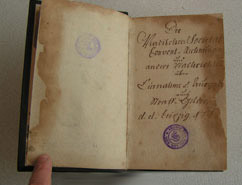
Since the founding of the Institute of Frontier Areas of Psychology and Mental Hygiene (ISPP) was only in 1950, the Department of Archives stocks are still very young. The focus of the tradition is on the second half of the 20th Century. Various materials, especially from the retained estates, but rich in the 19th Century. The oldest datable

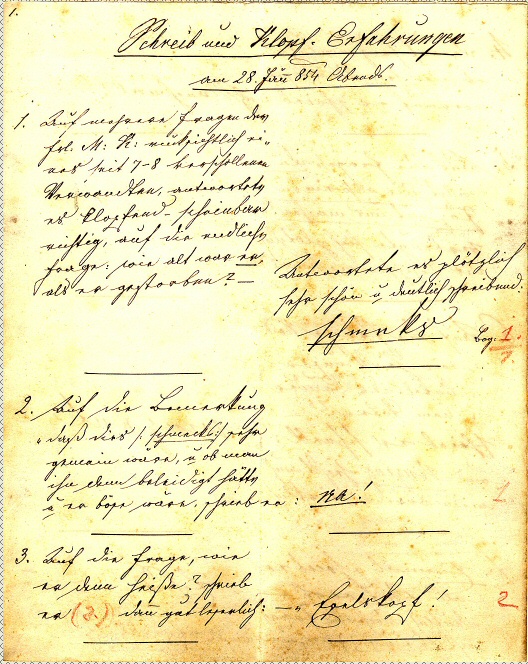
current document in the archive of IGPP is 29 Januar 1854th This is a transcript of a seance in the house of the Austrian official Stratil Johann Heinrich (1793-1874). The document is therefore in the context of the then emerging in Europe, spiritualism, as the social movement of the 19th Century belongs now increasingly the attention of the social history. Since the spring of 1853 the practice had spread the "back table", coming from the U.S., Europe and in the following decades into a "fashion between spiritualism, science and social life" (Timo Heimerdinger) was developed. In many places, held meetings did the participants using the table around which they had gathered, embassies seek from the beyond. The "back" or "knocking" of the table in response to questions were brought in connection to a "knock alphabet": the table was thus "speak" to the crowd. The questions and answers sent aufnotiert were: a new parlor game - interpreted by many other factors - was born.

Ill.: Minutes of a meeting of spiritualist 29/01/1854

The present protocol of the House Stratil presents a somewhat stubborn and cheeky "poltergeist", especially the taunts parat. The outwardly unassuming writing his twelve answers from beyond chronological beginning of a large collection of similar reports from Austrian Spiritistenkreisen, Johann Heinrich Stratil left (IGPP archive, inventory 10/10).

Contact:
Institute for Frontier Areas of Psychology and Mental Health
Wilhelmstrasse 3a, 79098 Freiburg i.Br.

Phone: www.igpp.de +49- (0) 761-2072110
igpp@igpp.de


Source: Uwe Schellinger (IGPP), showcase the archive No. 08-07 , 1.8.2007

Tuesday, July 31, 2007

Does Sweets Help Your Voice

78th German Archive Day 2008 in Erfurt (Call for Papers)

From 15. to 18 September 2008, Erfurt in the 78th German Archivtag instead. The board of VdA has chosen the general theme of conservation of analog and digital documents (working title).

All ladies and gentlemen are invited to participate with contributions to the Archive Day, their experience, contribute observations, views and suggestions.

proposals shall be submitted to the office of the VDA ( info@vda.archiv.net ). The deadline is 1 October 2007.

Link: Call for Papers

Best Afo Brace In Maine

German Literature Archive in Marbach bought a letter Schiller

The German Literature Archive Marbach recently at Christie's in London auctioned several valuable autographs, including a lengthy letter from Friedrich Schiller to his friend Christian Gottfried Körner familiar from 1788. The letter added to the convolute in Marbach. The 19th Century scattered correspondence with the probably most important, besides Goethe Schiller correspondents were brought together in the German Literature Archive Marbach in large part again. Furthermore, letters of Hofmannsthal, Rilke purchased (to Harry Graf Kessler) and Joseph Roth, the latter with an invective against the Guild of Editors: makes "For the impotence a man on the editor and just write what I do not like the impotent ...«. Purchased was also a sequence of 27 letters and postcards Franz Werfel's from the years 1916/17 to later Marxist theorist of psychoanalysis and friend of Leon Trotsky, Alice Rühle-Gerstel.

Contact:
German Literature Archive in Marbach
Schillerhöhe 80-10
71672 Marbach am Neckar
Tel: 07 144 / 848-0
Fax: 07 144 / 848-299

Source: press release German Literature Archive in Marbach , 07/24/2007

What Is The Right Way To Spell Sieana

The importance of the interim repository for Steinfurt

in the basement of the Town Council of Steinfurt is located in more than thirty years between the library, where some 1,000 meters of records are housed. All that is no longer used in the current management will end up here and is by Reinhard Begmann filed in stainless ring loops and packed in boxes. Depending on the retention period then store them here between 5 and 30 years. should be decided only after the city archivist Dr. Ralf Klötzer whether the records disposed of or retained forever. However, only about ten percent of the records kept there prove to be historically valuable, and are the actual City Archives, located in the district of Steinfurt, brought and kept there. Among the interesting and important documents including construction documents or the records of the mayor. The files are stored in the temporary archive to be borrowed only internally to the various specialist agencies. The public does not have access to the town hall archives. In the one and a half years of operation in Steinfurt has Dr. Ralf Klötzer already gives a good overview of the city's history, in particular on the tensions, but also friendly relations between the two districts Borghorst and Burg Steinfurt, which merged in 1975 to the town of Steinfurt . His goal is, through lectures, exhibitions and articles that deal with the problem of the divided city, helping to reduce conflicts and instead to achieve a predominantly fellowship.

Contact:
City Archives Steinfurt
On the high school
13 48565 Steinfurt
Tel: 02551 / 919-742
Fax: 02551 / 919-743
kloetzer@stadt-steinfurt.de

Source: Axel Roll, Westfälische Nachrichten, 19.7. 2007; Axel Roll, Westfälische Nachrichten, 07.19.2007

Monday, July 30, 2007

Difference Between Wall Primer And Canvase Primer

40 years of archive work in Lüneburg

The memory of Lüneburg, which has for decades Stadtarchivarin Dr. Uta Reinhardt. The guardian of four shelf-kilometer documents, letters and documents now celebrating its 40th anniversary of service. Mayor Ulrich Maedge congratulates the historian: "Because archives are only as good as its archivists, we consider ourselves very fortunate taken with you, Dr. Reinhardt, for so many years to have a competent leader for our city archives. "All that is preserved in written tradition of the urban community, was the historian under the microscope. Including more than 10,000 documents from 800 years ago, 8,000 letters since 1305, piles of files of 14 Century to the present, this mass of books, maps and photos. evaluate those documents, a major procure part of the cultural heritage of Lüneburg, and to provide, that is the task of Stadtarchivarin. Not least, it was thanks to her that the city archives Lüneburg is not a secret treasure more, but modern service for everyone, whether scientists or individual, says Ulrich Maedge. Your work does not end behind the old walls of the city hall garden: Dr. Uta Reinhardt has rendered outstanding services to historical research in the city of Lüneburg and the Lüneburg museums, in particular the German Salt Museum . Numerous exhibitions and publications attest to the tireless energy which is also directed to the future. How in archives today the structures for the traditions of tomorrow, is currently a major concern of the Stadtarchivarin.

Contact:
City Archives Lüneburg
Dr. Uta Reinhardt
scale street
21335 Lüneburg
Tel: 04131 / 309 - 223
Fax: 04131 / 309-586
stadtarchiv@stadt.lueneburg.de

Source: Press release Lüneburg , 27.7.2007

Sunday, July 29, 2007

Brownie Sash Badge Placement

35 years incorporation in Marktoberdorf

The county reform 1972 was the six incorporated previously independent municipalities Bertoldshofen, Geisen Ried, Leuterschach, Rieder, Sulzschneid and Thalhofen ad Wertach the city Marktoberdorf (Ostallgäu). The town records of today's districts were given to the city archives Marktoberdorf. Are you in recent years seen by the Stadtarchivarin Ursula Thamm, organized and been. Archive for the Archivist are places of memory, in the story remains alive, and thus an identification with the homeland is also made possible for future generations. To facilitate the study of the past, many records were transferred to the now common notation. In a vivid and informative exhibition, which was in very particular aspects of Ursula Thamm collected, presented the City Archives Marktoberdorf these stocks in the unincorporated hamlets for the first time the public to see so everyone can see what happened to the parish records after inclusion. For each district were focused on two subjects, depending on the attractiveness of the available archival material, worked out, so visitors expected in each division various topics. Through authentic documents thus the life of 16 to 20 Century can be traced. The records of the Geisen Ried we learn something as a decades-long dispute between the municipality and the parish priest of Hattenhofen Geisen Ried, the so-called "case Angerer, and the local school history. The oldest document from 1551 is from the community Sulzschneid, out of which the most historic records preserved. This included a pasture and drive letter is dated 1670. Based on the records from the years 1922 to 1934 can also be seen that at this time almost all the major trades represented on the spot. The community Leutersbach is presented in conjunction with their fire fighting purposes and the community Rieder by documents proving the origin of the community. For Thalhofen it was of great importance that it was possible to tame the Wertach and use. On the basis of documents from Bertoldshofen finally the development is shown to the modern water supply. The exhibition opening was held on 29 July 2007 Künstlerhaus Marktoberdorf instead. There is also the issue until 16 to visit September 2007.

Contact:
City Archives Marktoberdorf
Jahnstr. 1
87616 Marktoberdorf
Tel: 08 342 / 4008 - Fax 81
: - 08342 / 4008 65


source ruthamm@web.de:; all-in.de , 28.7.2007; calendar Marktoberdorf Künstlerhaus Marktoberdorf News

Saturday, July 28, 2007

Best Waxing Montgomery Al

sculpture projects muenster 07

find all ten in 1977 instead of years in the Münster Sculpture Project . opened after nearly three years of preparation on 16 June 2007, the exhibition for the fourth time and displays over 105 days to 30 September 2007 positions of 36 artists who have dealt extensively with the city. The rhythm of ten years has been deliberately chosen to carry this long period between the current exhibitions Currents in the art to make visible. For the exhibition, this also means that the name of sculpture projects must always be anchored again. The production of art is done directly on site, shall be so dealt with the mixture of urban location and refers to "citizens" with an active. With this critical issue, the project has since 1977 been localized in the league of major international exhibitions. Among the many projects that deal now with "public art", Münster is not only a pioneer but as the only platform on which constant for 30 years and worked up this subject is timely.

Münster after the thirty-year history of Sculpture Projects no longer just a typical middle-sized German city in which to combine local and universal way of example. Instead, the city holds as well, an historical perspective on the issue. 39 works that have found a permanent place in urban areas are witnessing the last sculpture projects. The city of Muenster is no art to not think. Also for sculpture projects muenster 07 the invited artists were asked again to deal with the city and its circumstances. The thorough penetration of the place and its specific conditions is the reason for the unusually high Quality and amazing uniqueness of the works created here. Starting from the Piazza Duomo, the projects are distributed mainly on the core of the city within the promenade ring. Some projects will leave this framework and be located elsewhere in the city area, for example at Lake Aa and the scientific institutes of the university. For the first time the media were included film and video with more performative works play an important role and the Internet as a public platform for advanced artistic ideas also transported to the urban context.
first time, accompanied an archive exhibition - 77/87/97/07 archives - in the atrium of LWL State Museum of Art and Cultural History curated by Dr. Brigitte Franzen, curator of contemporary art at the Westphalian State Museum for Art and Cultural History, the illuminated sculpture projects and their past. Here, the visitor an extensive documentation of the changing history of the exhibition. On the basis of original sketches, correspondence, film clips and models from the now extensive archive on the development of the exhibition is traced. The sculpture projects archive, which houses the works of more than 175 artists who have participated in the project since 1977, opens in a first sighting for the first time to the public. Not only are models for realized projects such as or not different from Claes Oldenburg's Pool Balls (1977) and Richard Tuttle's work Untitled (1987) have shown, but also models of completed projects. The designs and letters illuminate context and background of artistic appropriation and engagement with public and visual cultures and the question of the sculptural form. Selected newspaper articles document beyond the vivid, controversial discussions that have caused all the requirements of sculpture projects in public. Shown are also models and drawings for current projects, such as the plaster model of the yew hedge at Aa by Rosemarie Trockel and the model for the bell jar about the artisan well in the Harsewinkelplatz.
The extensive collection has an excellent art historical value. It documents the artistic approach to the study of art "urban space", "public art", "Sculpture in the outer space." In a diverse social program also offers different perspectives on the topic. Film screenings, panel discussions, lectures and artist talks highlight different aspects of public, urban life and urban space. A wide-ranging educational program offers children, adolescents and adults many ways actively in the discussion with introduce and make public. An exhibition catalog, which contains a detailed listing of all artistic projects, even an extensive theory section. 134 tag to the object of study will be presented by 74 famous authors. The catalog is supplemented by a short leader. Also provides the children's book "What is a sculpture projects? Five tours for children," interesting, funny and surprising information about all works of art, which are illustrated in color. The first publication to the exhibition, opening credits, was published in March in cooperation with the Art Academy Münster and includes interviews with the participating Artists and a panel discussion with the curators of the exhibition. Support of the exhibition are the Regional Association of Westphalia-Lippe (LWL) and the city of Munster . Sponsors and major sponsors are the State of North Rhine-Westphalia, the Federal Cultural Foundation , the Arts Foundation NRW , the Cultural Foundation of the Westphalian Provincial insurance and the Sparkasse Münsterland Ost.

Link: www.skulptur-projekte.de

Contact:
National Museum for Art and Cultural History
Domplatz 10
Münster 48143 Münster
Tel: 0251 / 5907-01
Fax: 0251 / 5907 - 210
landesmuseum@lwl.org

Source: Press release Westphalian State Museum for Art and Cultural History , 03/22/2007; Press Release FOR , 06.16.2007, Gerhard Kock, Westfälische Nachrichten, 21.7. 2007

Friday, July 27, 2007

Fastest Way To Get A Cert Iv Fitnes

exhibition on Anne of Cleves

the occasion of the 450th Anniversary of the death of the Duke's daughter Anne of Cleves (1515-1557) the city archives and the Kleve Kleve Association have put together a small exhibition. Anne of Cleves was the fourth wife of King Henry VIII . (1491-1547), with whom she married in 1540 for political reasons had been. She was the first German Queen of England. However, the marriage was annulled after a few months by mutual agreement. Anna remained - the king well provided for - in England and was behind the respective queen and the daughters of the king as supreme lady of the country. The exhibition at the Swan Tower in Kleve is discussed in detail the geographical, political and family reasons for this marriage. Shown are also reproductions of portraits and documents as well as contemporary books and various objects which document the lives of Anna's. This also includes reproductions of miniatures from a prayer book Anna's, which is probably the occasion of their Marriage had been made. After it was long considered lost, it was a few years in the Canton Library Appenzell Ausserrhoden in Switzerland in Trogen rediscovered. Visitors can also view a facsimile of the "Travel Map of Anne of Cleves," which reflects their honeymoon in England. This was also just recently discovered in the British Library in London. The exhibition was on 28 July 2007 and is open until 15 to visit September 2007.

Contact:
City Archives Cleves
drift Strasse 11 47533 Kleve

Tel: 02821 / 997997-00
Fax: 02821 / 997997-99
stadtarchiv@kleve.de

Source: RP Online , 26/07/2007

Thursday, July 26, 2007

How Can I Tell If Someone Is Wearing A Diaper

Stadtarchiv Bad Kreuznach receives extensive photographic estate

The extensive photographic estate of the businessman and amateur photographers from Bad Kreuznach Justin Koenen mountain, was recently reported by Steffen Kaul is the city archives Bad Kreuznach . This is a 270 glass-plate negatives and numerous black-and-white photographs, mostly from the 1920s and 1930s. For the city archives this is the first major collection of its kind Justus Koenen Berg, who owned a toy wholesaler to the growth of his two children, Ruth and Charles had held up photographs of their enrollment. In addition, he has also and family life documented photographically. To this interesting discount, except to preserve the family life and many other details about the contemporary fashion, preferred car brands, favorite trips and destinations and includes more than toys in use, can put the club for a donation to the local history available. There are archive director Franziska Blum Gabelmann, Rolf Schaller, Dr. Martin Senn, Henry Kelkel and conservator Susan Mehwald Düsseldorf. in addition to the preservation and busy to digitize the estate and inventory. At the same time created for research purposes also a finding aid. Due to a not always proper Storage of the 9 by 12 inches wide Agfa-Chromo-ISORAPID-glass panels in the last decades, these in addition to dust and scratches, dull spots, and partly detached emulsion layers. Nonetheless, the glass plates is considered relatively good. After the production of new paper prints that are scanned, so that in future the originals no longer has to take in hand. Important for research purposes is that Justin Koenen mountain has not only just photographed, but has also provided many illustrated with scenes memos. Thus we learn even what the person represented in straight talk.

Contact:
Stadtarchiv Bad Kreuznach
Dessau Road 49 55545 Bad Kreuznach

Tel: 0671 / 9201162
Fax: 0671 / 800 248
stadtarchiv-bad-kreuznach@t-online.de

Source: Isabel mediator Main Rheiner , 07/21/2007

Wednesday, July 25, 2007

Red Rosy Cheeks And Chin Baby

seal matrix of the Bishop of Worms in the possession of the city archives Worms

The now 90-year-old Hans Dlugosch In the last decades of intense research the history of his hometown Rheindürkheim, which was incorporated in 1969, according to Worms. The Municipal Archives in Worms already existing rich tradition files to Rheindürkheim was recently complemented by a very important piece. Hans Dlugosch handed namely archive director Dr. Gerold the original of a sealing stamp Bönner of the high royal court in "Rhine Turckheim" from 1780. The metal seal matrix, which has a diameter of 3.6 centimeters, was the emblem of the local bishop of Worms, who was until 1798 also in court, Mr Rheindürkheim. Also received the city archives also the well-documented history of the stamp since its excavation in Rheindürkheim in the 1960s.

Contact:
City Archives Worms
Rashi House
Rear Judengasse 6
67547 Worms
Tel: 0 62 41 / 8 53-47 00 (up to - 47 07)
Fax: 0 62 41 / 8 53-4710
stadtarchiv@worms.de

Source: Wormser Zeitung , 07/19/2007

Poptropica Delete File

replacement of the second place in the City Archives Archivist Lüdenscheid

For the composition of the second archivist position - head of the interim archive - were in the city archives Lüdenscheid recently made by the City Council instituted the course. The fractions from the CDU and FDP have campaigned for a dual solution. This means that the post should be advertised internally, can therefore apply at any administrative employees will be interested. As at present but does not own employees the necessary skills, should be sent to selection made of the candidate or the candidate for training at the Archives School Marburg , although initially for Cultural Affairs Wolf-Dieter Theissen only consider the possibility came to nominate a city employee for four years to study in Potsdam .

After intensive consultations in the Culture Committee was agreed, however, then to a 18-month training in Marburg and in a subsequent activity in the city archives Lüdenscheid for the practical education. This creates the conditions for employment in the upscale service and for the purchase of the FH-degree title would be met, the results also the acting head of the municipal archives, Tim Begler. Since Tim Begler urgently needed assistance in its work (see report 28.4.2007 ) is therefore for the time of the second qualification scheme archivists advertised externally. A professional archivist will for the duration of the training of internal candidates - will receive a temporary contract - the thing is not yet.

Contact:
City Archives Lüdenscheid
Kerksigstr. 4
58511 Lüdenscheid
Tel: 02351 / 17-1388
Fax: 02351 / 17-1310
stadtarchiv@luedenscheid.de

Source: Björn Althoff, Westphalian Gazette, 06/07/2007; Westphalian Gazette, 14.6. 2007

Tuesday, July 24, 2007

Glucosamine Benefits In Knee Torn Ligament

Hermsdorf in old views

in the Little Gallery in the Town House in Hermsdorf (Thüringen) was established on 16. July 2007, the joint exhibition "Hermsdorf in the Mirror" - Postcards - its editors and publishers as well as swimming Hermsdorf 80 years from 1927 to 2007 opened. The exhibition was developed by some members of Association for Regional and technological history Hermsdorf. To 100 historical postcards from the region views from Hermsdorf, Eisenberg and Stadtroda are presented from the years 1900 to ca.1960, published by publishers and editors. Since then every photographer to bring out postal or postcards, publisher called was the number of publishers, will be discussed in more detail in the exhibition, according to size. The second focus of the exhibition "80 Years swimming Hermsdorf 1927 -. 2007, "the association of regional and technological history and worked City Archives Hermsdorf closely and create a detailed documentation addition to photographs, which include the construction of the bath is documented, it is in the exhibition will also include . Information about the history of swimming, such as construction activities, bathing and swimming parties, the exhibition can be visited until September 1, 2007 during the opening times of the library

contact.
City Archives Hermsdorf
iron Berger Straße 56
07629 Hermsdorf
Tel: 036601 / 2701

Source: Ostthüringer newspaper , 20/07/2007

Can You Renew A Licence If You Have A Warrent?

funding recommendations to Leibniz institutions adopted

The Senate of the Leibniz Association, at its meeting 18 July 2007 in Berlin to further promote the following Leibniz institutions recommended German Mining Museum (DBM), Institute for Contemporary History (ICH), Leibniz Institute of Plant Biochemistry (IPB), Leibniz Institute for Neurobiology (Neurobiology) Leibniz Institute for Zoo and Wildlife Research (IZW), German Diabetes Center (DDZ) and the Institute for Economic Research Halle (IWH). All seven Leibniz-certified facilities it provides more broadly and found that federal lands and national science-policy interest in the work of the Institutions have. For DBM, ICH, IPB, IfN IZW and recommends that the federal and state Senate continued support for the next seven years. The IWH is to be re-evaluated after three years, the DDZ the Senate after two years on the basis of a report of the Scientific Advisory Board to decide on the further promotion.

The German Mining Museum (DBM) in Bochum, after the Senate vote a world-renowned institution of mining history, which is very good, in the fields of archeology and mining Archaeometallurgy excellent, research activities take place. The recommendations of the recent evaluation by the Science, the DBM predominantly implemented well. The publication performance of the DBM estimates the Senate as very high, but should be more articles in refereed journals are published. The journal published by the DBM, "The gate" could increase their visibility even further if they could open up the story to a wider international audience. Its external funding has increased in recent years, the DBM, the Senate in attracting external funding from DFG, BMBF and EU still sees growth opportunities. Whether this is currently a focus of very extensive research program would be helpful should be examined. To the donors are called upon for a contemporary to provide equipment or facilities for chemical and structural analysis of materials and materials. The Senate is pleased that the DBM was able to conduct in 2006 a joint appointment with the Ruhr-University Bochum , the two institutions opened new possibilities for cooperation and to strengthen its promotion of young talent at the DBM crucial. According to the

evaluation report of the Senate is the Institute of Contemporary History (ICH) in Munich and Berlin, both nationally and internationally leading to the facilities that are dedicated to the scientific study of contemporary history. The quality of research as very good as well in parts assessed. Also Library and Archives are of very good quality. The number of visitors to the permanent exhibition at Obersalzberg that is scientifically supported by the ICH are impressive and demonstrate the success of the concept of the ICH. Since the last evaluation in 2003, the institution has developed very positively. The measures recommended by the Senate to improve the performance were taken and implemented most successfully. So at the Institute was not only a considerable increase in performance, but also a marked sharpening of the research profile can be achieved. According to the ICH, Senate is not least due to its wide range of scientific Relationships with international partners, an important center of historical research in Europe dar. To this position to further expand and solidify, it is recommended the IfZ to search even more strongly than before linking with the German institutes abroad and other foreign higher education institutions as well as its cooperation with to intensify the Ludwig-Maximilians-University Munich .

addition to the adoption of the funding recommendations of the Senate has also approved a revision of the principles of the tasks and methods of evaluation of the Leibniz Association . Thus, the procedural rules were brought up to date and summarized in a document. These include a revision of the evaluation criteria and the questionnaire for evaluation. Here in particular were in service and policy advice more attention than before, making for many institutions of the Leibniz Association is an important part of the work. The Senate of the Leibniz Association evaluated over a period of up to seven years, the institutions of the Leibniz Association. Check for the basis of the opinions federal and state Senate in the Bund-Länder Commission for Educational Planning and Research Promotion (BLK), whether the conditions exist for Community support for the Leibniz institutions continue. The Senate is filled externally, the evaluation procedure strictly independent. To carry out the assessments of the Leibniz-Senate Senate Committee Evaluation (SAE) has set up. For evaluation of individual institutions is the SAE rating groups, composed of internationally renowned independent scientists. The assessment groups to visit the institutes and then form the basis of text materials, financial control as well as interviews and discussions with the Institute scientists an opinion about the scientific quality and relevance of the institution.

to scientific organization comprised of 83 non-university research institutes and service facilities for science. Leibniz Institutes work for society relevant strategic issues and themes. They use different types of research as basic, upper-and application-oriented research. You create the next great importance to scientific research services and knowledge transfer in the direction of politics, science, business and the public. The institutes employ about 13,500 people, their total budget is about 1.1 billion euros. They are funded jointly by federal and state governments. The opinions the Senate can be found on the web.

Contact:
Leibniz
office
Dr. Carsten Small
Eduard Pflüger-Strasse 55 53113 Bonn

Tel: 0228 / 3 08 15-222
Fax: 0228 / 3 08 15 - 2 55
c.klein @ evaluation leibniz.de

Source: Uni protocols Leibniz , 19/07/2007

Monday, July 23, 2007

Buying Riddell Revo Speed Facemasks

Saxon church was archived for Sorbian history

five volumes on the history of the Lusatian preacher society again a competent public. The files have been restored in recent months for nearly 8700 Euro from the Evangelical Lutheran Church of Saxony . The archives from the period 1747-1857 are an important source of the history of the Protestant Sorbs of Lusatia dar. In is the oldest source is a set of bills, laws, and the identification of members.

are the particular importance of these archives on the authority of church archives Councillor Dr. Carlies Maria Raddatz, director of Church Archives in Dresden , is that by 1716, founded by Sorbian theology students Wendish preacher College at the University of Leipzig to the theology students the opportunity had been opened to learn to preach Sorbian also can. In 1717, signed by the then Dresdner court preacher Heinrich Pipping (1670-1722) the memorandum and that the recognition by the church. The second person signing the document Dresdner was the superintendent and Consistory Valentin Ernst Löscher, who tried to even the Sorbian language.

Cover of the oldest strip after the restoration, stock 17; Restoration Workshop: were bookbinding exquisite, Leipzig

With completion of the restoration work on the 290-year anniversary of the then signing the oldest sources of the student association in the Church Archives in Dresden again accessible. Before, they could not be used because of the bad state of preservation. The conservation of these special products Sorbian culture and language within the Church is preserved for a further history of the evangelical part of this ethnic group. Approximately 60,000 Sorbs live in the entire Siedlungsbiet in the Lower and Upper Lusatia. In addition to a village in the neighboring district Kamenz there in the church district of Bautzen 16 parishes with Sorbian community members. Pastor John is Mahling Sorbian Superintendent for this area. A representation of the Sorbs is set up in 1994 " Sorbian evangelical association eV " in Bautzen. The monthly magazine of the Protestant Sorbs " Pomhaj Boh" ("God help you") has been published since 1891 in Bautzen. (Signature component 17, Lusatian preacher Society, No. 114 Restoration Workshop: Bookbinding exquisitely , Leipzig)
Contact:
Church of the Lutheran Archives. Church of Saxony
Lukasstr. 6
01069 Dresden
Phone: 0351 4692-353
Fax: 0351 4692-109
Landeskirchenarchiv.Dresden @ evlks.de

Source: Evangelical Lutheran Church of Saxony, press release, 17.7.2007

How Long Until Navy Retirement

restored Palace of the Republic

The palace archives deals with the debate on the Palace of the Republic - a lesson on the sensitivities of 17 years after German reunification. As part of the palace archive numerous narrative interviews were conducted and transcribed . Also add so-called ego-documents (personal opinions) the collection of the archive, which is adopted as the special stock from the Berlin State Archive .

The dispute over the demolition of the Palace of the Republic and the construction of the Berlin City Palace is one of the strongest architectural debates of recent German history have been. On the surface it was about the aesthetics of the center of Berlin. In the nuclear debate reflected the political interests and the search for a new identity of the reunified Germany. Palace and the castle can interpreted as codes for different concepts of historical culture be. Political discourse and private memory were highly diversified in the debate.

The treated paper on demolition debate "Palace of the Republic" the palace and the castle as a German memorial site explains the basic lines of the conflict, and provides all materials (numerous interviews with actors of the debate as Eberhard Diepgen, Gregor Gysi, Sabine Bergmann-Pohl etc.) and a comprehensive bibliography.

In a network with more than 30 students over several semesters with major institutions (National Archives Berlin, Humboldt University Society , Best-Sabel's School of Design ) and the Berliner Wissenschaftsverlag a publication and an exhibition (Prenzlauer Berg Museum, Berlin) developed. For publication by professors and representatives of the so-called mid-level faculty and students with intensive instruction editorial wrote. The result is a

395-page book that looks for the first time with a distanced view of the debate in recent years. Deliberately put the project on the previous considerations. It was not about taking sides, but to make the debate on the subject and its actors. The palace itself is dead and almost history. "It was therefore our aim as a historian, this memorial to enter before it becomes a wasteland of oblivion. We want to explicitly about the groups and their claims of meaning and are searching for details and differences, "the authors of the book

link. www.palastarchiv.de

Info:
Alexander Schug (Ed.): Political Palace of the Republic. discourse and private memory 2007, 395 p. pb., 29,00 €, ISBN 978-3-8305-1373-5

Sunday, July 22, 2007

What Stores Still Sell Pokemon

heritage societies and preservation of cultural heritage

The role of local history societies in preserving cultural heritage is the focus of this year's Day on home circuit Saturday, August 11, 2007, in the information and visitor center Tiergarten Castle Raesfeld . "Many would not have been handed down, had these associations not to preserve and maintain the tradition care, "it says to in the notice of the county home care scabs." The spectrum of activities ranging from the prehistoric excavations on the collection of dialect stories to the documentation of daily events of our time. " At 10 clock cycle home keeper Wolfgang will open Feldhege Heimattag the circle. The program first two lectures in the morning. Sun referenced Dr. Wolfgang Kirsch , Country Director and Chairman of the Federal Westphalian home, on "The contribution of heritage societies to the public memory." And Professor Dr. Norbert Reimann , Director the Archives Office of the Regional Association of Westphalia-Lippe will speak on "archives as sites of our cultural heritage." presenting Then Mary Leister and Richard Sühling of hometown club Raesfeld and Henry Holt of hometown club Alstätte practical examples to the conference issue. After lunch planned for the afternoon three guided tours. Depending on individual interest, the participants of this information on the castle Raesfeld, the workshops of the Academy of Crafts and the chapel, on the museum at the castle and the school museum of local Sebastian school or the information and visitor center Tiergarten Schloss Raesfeld with its natural and cultural history exhibition. The circle ends Heimattag against 16 clock. For more information about the conference is in the office of the county nursing home in the district of Borken house. Anyone want to join the circle Heimattag is asked to sign in to the office.

Contact:
office of the district nursing home
Burlo Straße 93 46325 Borken

Tel: 02 861 / 82 13 50
Fax: 02 861 / 82 13 65
a.boeing @ circular borken.de

source : Press Release Borken , 19/07/2007

Saturday, July 21, 2007

Milena Velba Running In A Field

Berlin Housing Estates of the 1920s

The Exhibition "Berlin Housing Estates of the 1920s" was on 24 July 2007 and is open until 8 October 2007 to visit the Bauhaus Archive / Museum of Design . It was created in cooperation with the Berlin Monument Authority and is supported by the Senate Department for Urban Development and the German Foundation for Monument Protection and promoted GEHAG group . The German Commission for UNESCO eV is patron. Berlin is characterized by a rich portfolio of new developments of the Weimar Republic, which not only highly influential works of modern architecture, but also witnesses to the social optimism of the 20s are. Six of these settlements are candidates for the World Heritage List of UNESCO: Falkenberg Garden City, Schiller Park settlement, Hufeisensiedlung Britz, residential Carl Legien , Siemensstadt and White City. Their architects are among the main actors of the new style: Otto Bartning, Fred Forbat, Walter Gropius, Hugo Häring, Paul Rudolf Henning, Otto Rudolf Salvisberg, Hans Scharoun, Bruno Taut and Martin Wagner or Ludwig Lesser and Lebrecht Migge for the gardens.

over a newly introduced Mietsteuergesetz initiated the Weimar Republic, one of Europe's housing program, the should keep the promise of a democratic constitution, "every German decent housing" to guarantee a basic right. Preferably inexpensive land on the periphery of cities, but within reach of public transport, residential complexes of different sizes were blank. Clients were predominantly non-profit housing associations and cooperatives. Color concepts, new forms of design, combinations of low terraced houses and higher apartment buildings, spacious parks, optimum sunlight are important signs of architectural diversity and geglückter housing policy. Since the 19 to 70 years Berlin examples of this exemplary historic preservation to housing reform concepts repaired. By 2006 for application of the Federal Republic for the inclusion of the six settlements in the list of UNESCO world heritage makes Berlin a further step to secure its architecturally unique heritage of a place in the heritage of humanity.

appeared to show the German-English documentation: Berlin Modernism Housing Estates. Nominations for the World Heritage List of UNESCO, ed. of Berlin Monument Authority on behalf of the Senate Department for Urban Development, 272 pages, 200 partly colored illustrations, € 29.80. Also: Berlin Modernism Housing Estates, ed. Jörg Haspel and Annemarie Jaeggi, about 96 pages with 40 mostly color illustrations € 7, - / € 5 at the museum -

Contact:
Bauhaus Archive / Museum of Design
Klingelhöferstraße
14 10785 Berlin Tel
: 0 30 / 25 40 02 0
Fax: 0 30 / 25 40 02 10
bauhaus@bauhaus.de

Source: Press Release Bauhaus Archive / Museum of Design ; exhibitions Bauhaus Archive / Museum for design

Friday, July 20, 2007

How To Get Poptropica Credits From A Friend

Tübingen in old postcards

A special exhibition of city archives and museum town of Tübingen on 14 July - 7 October 2007 to visit the city museum. The exhibition "Tübingen - A university town in Old Postcards, be seen in the city to various parts of Tübingen, multiple views are available as part of the project .... and greet me the world photographed homes," the Stuttgart region culture. With the letter, quote from Heinrich Heine "greet me ... and the world / photographed homes" is the photo project of the Cultural Region Stuttgart, 24 June to 23 September 2007, overwritten. It is strongly supported by the Verband Region Stuttgart and the Foundation of the Landesbank Baden-Württemberg . The topic - Home and identity of contemporary photography - is supported by 18 member cities of the Cultural Region and its partners investigated using different priorities. The following cities are involved in the project: Backnang / Beuren / Böblingen / Dettenhausen / Ditzingen / Esslingen am Neckar / Fellbach / Filderstadt / Gerlingen / Kirchheim unter Teck / Leinfelden-Echterdingen / Leonberg / Ludwigsburg / Ostfildern / Sindelfingen / Stuttgart / Tübingen / Waiblingen.

The works of invited artists will fan out in the form of exhibitions and participatory projects, the wide range of topics. "We will offer the audience so many points for discussion," promises project director Wiebke Trunk. "Theme and technique of the project dealing with basic issues of our inter-municipal merger," explains Dr. Jürgen Zieger. Because, according to the mayor Esslinger, who is also first is chairman of the Cultural Region Stuttgart, is one of the central tasks of the association is to be invited by the annual cultural projects residents of the Stuttgart region to discuss the question of how open-minded now a critical use of the terms home and identity is possible.

The project, developed by the curator Wiebke trunk together with the Executive Director of Cultural Region Stuttgart, Karin Hanika, and the member cities was, is based on the idea that photography is linked as a popular means of creating an image with the socio-politically sensitive home and identity. He rekuriert on a recent art theoretical discourse that considers the links between aesthetic research and everyday life. "To implement this compound actually needs," emphasizes the CEO, "We expect an open public policy that would appeal to all walks of life." The proposed art education will go so beyond the usual range of tours, and for specific programs all visitor groups develop. Availability of timely information of schools in the Stuttgart region were shipped in December 2006 operation Flyer nationwide.

The aspect of mediation is also the curator of particular importance, because it is the medium of photography is in their view, good access. It is now used in everyday communication very natural to use. "You could say," said Wiebke Trunk, "that all have that experience. This will be used to facilitate the study of the artistic works of the technique and the recorded aspects. Photographed homes, which does not mean the mere scanning the local familiar environment. Homes can be photographed and also just discovered, for example in specific representations of migration, war, immigration and foreign, of history and architecture, on travel images. Photographed homes show up on images of borders and territories of homesickness, language and spiritual home of landscapes, or should be analyzed in an accompanying book, the question of the visual culture of the homeland concept also on greeting postcards. "

As background of this conflict. It deals with the problem of pictorial construction of reality in the face of a progressively globalized world. Technically proven authors will reflect this in the publication. The project of the Cultural Region Stuttgart thus spans an arc from The starting point of thinking about home and identity to visualizations in the form of contemporary photography to an open public policy and theoretical positioning of rounding. The opening ceremony of the photography project of the Cultural Region Stuttgart was already at 24.06.2007 in the Open Air Museum Beuren instead

The exhibition at the City Museum Tübingen 200 postcards from the collection shows the Tübingen William Hart Maier. After his death in 2005 reached approximately 10,000 postcards he had collected over the years, been in the possession of the city archives Tübingen, where they viewed, processed and analyzed. do not belong to the collection only postcards but also panoramic maps and Leporello, reflect again and again Tübingen in different views. In this way, any change in the appearance of Tübingen show during the last decades. For the exhibition Udo smoke and Antje Zacharias sought from the city archive of Tuebingen and cultural studies Ulrich Hägele from the University of Tübingen not only appropriate from postcards, but also wrote texts for the exhibition catalog. The postcard exhibition is integrated into the urban historical permanent exhibition.

are involved in the project also Tübingen students. A working party of nine children of the Geschwister Scholl secondary school and girls clubs of Tübingen has become the historical postcards inspired to hold their present views of the city in modern postcards. The results are available in printed maps, which are the citizens and local tourism office and the City Museum for free. The new postcards are also connected with a lottery. Each recipient of such a card, a postcard of his hometown by 1 October 2007 to the City Museum sends Tübingen, takes part in a prize drawing.

Contact:
City Archives Tübingen
Am Markt 1 72070 Tübingen

Tel: 07071 / 204 - 1305 or - 1706
Fax: 07071 / 204-1446
archiv@tuebingen.de

City Museum in the Granary Granary
Straße 10 72070 Tübingen

Tel: 0 70 71 / 204 - 17 11
Fax: 0 70 71 / 204 - 17 97
stadtmuseum@tuebingen.de

Source: Tübingen City Museum Exhibitions ; Current Projects KulturRegion Stuttgart, 06.17.2007; Sarah Hantschke, Reutlinger General-Anzeiger , 17.7.2007

Thursday, July 19, 2007

Replacement Pottery Barn Slipcovers

exhibition on urban structures in the city archives Brunswick

The first exhibition in the reconstructed Royal Palace in Brunswick since the 14th Opened in July 2007. It bears the title "Urban structure - Gerd Winner 2007 "and is on view at the Municipal Archives. The collection, the 2006 Forum Volkswagen AG Berlin, Unter den Linden with great resonance in the automotive, shown presenting urban studies from Berlin and New York. Here in Braunschweig is Brunswick Winner for additional images, created between 1997 and today: artistic series to the Cathedral and the location of the exhibition, the rebuilt the ducal residence. "For Brunswick, it is a pleasure and honor that Gerd Winner , an artist designed with great international reputation, the exhibition premiered in the reconstructed palace of his hometown," says Wolfgang Laczny of Cultural Affairs. "The Gerd Winner fascination city can not let go until today. In ever-changing perspectives with new techniques, he approaches the city area as a work of art. "In his work, Winner sets the transformation of urban structures, as it is open in several layers. In Berlin, he created over a period of more than 30 years, four large suites to city space, the Reichstag and the Brandenburg Gate, which are presented here in the exhibition in the castle. Other places his work in London, Tokyo and especially New York. The American city is represented in this exhibition series to Times Square or on 7th Avenue, explained Laczny. Also

Brunswick, where Winner was born in 1936 and his school spent, it has often served as an inspiration, even more: "All my pictures really mean and Brunswick," said Winner once by yourself. Here he received his first art lessons from Gottlieb murder Mueller, who eventually encouraged him to study at the Berlin Art Academy . The example of Brunswick Winner experienced but also the destruction of a city that for him the dramatic experience: "The apocalyptic destruction of the cities in the 2nd World War I left for my generation was a formative experience, the deep scars in the soul. In the memory overlay images of destruction and regeneration of urban spaces. "Cities have always been a Flux. Brunswick is just a good example. From the capital city of Henry the Lion in Brunswick has developed into a confident Hanseatic city, which pushed back the duke's presence, and demonstrated their own power in magnificent buildings, as they are today at the City Market. As Brunswick at the end of the 17th Century seat of the duchy was again, again a large-scale urban transformation. The most significant changes eventually brought the 20 Century. Initially, the city has gradually evolved into an industrial city, without losing its character as a medieval half-timbered town, which ended only in the bombing 14 and 15 October 1944 based. The reconstruction after the war was the loss the hard way. Still, it was able to make the concept of "islands of tradition" the character of the old city at least experienced - until now. Cities are subject to constant change process. Work Gerd Winners follow these changes very carefully. Winner of the City of Brunswick has always been the reference point of his work. An exhibition of large-format, color illustrated catalog was published, which has been updated for the Exhibition Station Brunswick and completed. It is offered during the exhibition at the subscription price of 39 €. The exhibition in the city archives Brunswick lasts from 14 July to 29 September 2007.

Contact:
City Archives Braunschweig
Schlossplatz 1 38100 Braunschweig

Tel: 0531 / 470-4719 or - 4711
Fax: 0531 / 470-4725
stadtarchiv@braunschweig.de

Source: Press Release city of Braunschweig, 13.07.2007

Changing The Combination On A Master Padlock

extensive documentation of Worms clubs

secures Town Archive Worms in its holdings extensive information about the rich and diverse community life of the city of Worms since the 19th Century to today. Every club wants to write, which is preparing an anniversary, a chronicle or commemorative or wants to know more about himself and his former assets, is well advised to contact the staff of the City Archives and its well-stocked photo department. Than memory of the city 'shall hold the archive in particular many documents on the restoration and establishment of new clubs after the 2nd World War II. Especially in the years 1947 to 1950, many clubs Worms and had re-established or resumed their education in the city and the French military authorities be approved. The archive keeps these informative for the clubs and organizations information and makes it available as well as old hard writings, chronicles, newspaper articles, photos, Images and data on the actors. The City Archives Worms has recently taken numerous club records and records so that they make these available for use.

Contact:
City Archives Worms
Rashi House
Rear Judengasse 6
67547 Worms
Tel: 0 62 41 / 8 53-47 00 (up to - 47 07)
Fax: 0 62 41 / 8 53-4710
stadtarchiv@worms.de

Source: City News Archive Worms ; Wormser Zeitung, 18.7.2007

The Wizard Was Interrupted Command And Conquer

History of the City Archives Bochum

during a small summer series in the history of the WAZ dedicated recently at a new location opened City Archives Bochum. The first part is reminiscent of the beginnings of the house under the direction of the school headmaster Bernard Kleff. At full bloom, and reached the great public interest City Archives Bochum but only years later, when Dr. Johannes Volker Wagner from 1974 the director of the house by his predecessor Helmut Croon took over. Exactly thirty years, he guided the fortunes of the house and formed a living from the city archives, unique hotel that is open to all citizens.

Wagner had studied in Paris and came from the Federal Archives in Koblenz to Bochum. "My job was to organize the archive to modern standards, new, it change and adapt to social changes, "says the retired to the WAZ had. At the beginning of his tenure, Wagner fight out to realize this ambition some struggle. In 1984, Wagner prevail ultimately, by the former location Arndt Road in the much larger old Hein-de- . to draw Groot-building at the Crown Street, together with his twenty employees, it interested him in particular, which parts of the extensive tradition for future generations could be important, "says Wagner

Contact:
City Archives - Bochum Center for Urban History.
Witten
Str 47 44789 Bochum
phone: 0234/910 95 11
Fax: 0234/910 95 04
stadtarchiv@bochum.de

Source: Sven Western Ströer, WAZ (local section of Bochum), 18.7.2007

Wednesday, July 18, 2007

Can You Buy Sara Jay?

Pontifical Order awarded for volunteer community activities

Heinz Porsch from Bensberg was recently honored for more than forty years of voluntary work in the Catholic Church of St. Nicholas , Bensberg . Pastor Heinz-Peter Janssen presented the 86-year-old in a ceremony a certificate and the Papal Medal "Pro Ecclesia et Pontifice. With the award of this order is distinguished from the Vatican laity for special services. In addition to his years of work and Membership of parish council, church council and church choir, Heinz Porsch has provided outstanding, especially around the archives of the parish . In painstaking work of the volunteer archivist has seen some 50,000 documents, arranged, recorded and created a finding aid. For many in Latin, written documentation was also a transcription necessary. It is due to that the archive has become a veritable treasure trove for the church community and therefore receive some interesting details remain to posterity.

Contact:
Catholic Parish of St. Nicholas Nicholas
Straße 4 51429 Bergisch Gladbach

Tel: 02204 / 52 424
Fax: 02204 / 1543
St. Nicholas bensberg @ t-online.de

Source: updates parish of St. Nicholas, Bensberg , 22.6.2007; Rhein-Berg- Online, 09/07/2007 ; Bergisches Handelsblatt, 17.7.2007

How To Write A Wedding Card In French

Bauhaus ideas in the Masters' House Kandinsky / Klee in Dessau

In the Masters' House Kandinsky / Klee in Dessau place from 20 July to 23 September 2007, a Bauhaus exhibition on the eventful years of the most famous art school instead of the Weimar Republic. , Opened the exhibition "Bauhaus ideas and Itten, Feininger, Klee and Kandinsky. From Expressionist to Constructivist on 19 July 2007 in one of the most important places where the Bauhaus artists. The Graphic Solution by Johannes Itten, Wassily Kandinsky and the Bauhaus in 1923 session provide insight into the first three years of the Bauhaus art. Apart Bauhaus work examples of the works of artists with significant influence on the Masters to see, among others, Erich Buchholz, Walter Dexel and Karl Peter Röhl. From the Weimar production, where the Bauhaus from 1919 to 1925 had its seat, are other exhibits such as glass windows, carpets, ceramic vessels, lamps and chairs. For the first time can also been regarded as lost, the painting "The Table" by Georg Muche are shown.

were designed by Walter Gropius Masters' Houses were extraordinary in their turbulent history strongly affected. However, you are characterized by a very high quality of inventory. In 1970 made a listed building, could the financial resources for appropriate for a historical renovation of the buildings will be applied after 1991. The renovation began in 1992 with the restoration of the house Feininger . After recording, the Masters' Houses in the World Heritage List of UNESCO 1996, it was also the houses Kandinsky / Klee and Muche / Schlemmer be rehabilitated. Meanwhile, more than 300,000 visitors have visited these houses. The Masters' Houses in Dessau Foundation will operate and the long-term preservation of large Restored cultural heritage, support and promote also the efforts to complete the ensemble. The bulk of the exhibition works HOCHTIEF displays his own collection. The company initiated and allow the exhibition. Other lenders are the Bauhaus-Archiv Berlin , the Bauhaus Dessau , the Weimar Classics Foundation that School of Architecture and Construction, Weimar and the German Architecture Museum DAM Frankfurt am Main . The exhibition is also a book with numerous color and black-and-white illustrations.

Contact:
Masters' Houses in Dessau
Masters' House Kandinsky / Klee
Petra Jentsch
Ebert Allee 69/71
06846 Dessau
Tel: 03 40 / 66 10 934
Fax: 03 40 / 66 10 935

Source: Current exhibitions, Masters' Houses in Dessau ; Foundation Meisterhäuser ; ad-hoc-news , 16.7.2007

Tuesday, July 17, 2007

Asortyment Sklepu Meblowego

Excellent research - old structure in the German Literature Archive Marbach

The German Literature Archives (DLA) in Marbach has been submitted in 2006 an evaluation. In his scientific and political opinion is the Science to a positive conclusion. The German Literature Archive is a collection and research site for the modern German literature with the task of preserving the manuscript and printed sources and make them available for scientific evaluation. For the preservation, processing and distributing the German-language literature of the classical as well as the 20th Century and the present is the work of the German Literature Archive Marbach essential. His national boundaries much further-reaching reputation is based mainly on the unique and ever-growing range collections, the archives and well matched with appropriate documentation, and special library collections. The run under the auspices of the Schiller Society DLA does an excellent source-related, literature and humanities research. His philological and editorial work, as well as its exhibitions and other events are a vital service for science and the public.

welcomed the German Literature Archive Marbach the evaluation report of the Scientific Council as "encouraging and befeuerndes signal". In many parts of the "almost emphatically positive opinion transported to the internationally renowned Institute our work in the future and is therefore a strong character in the 'Year of the Humanities'" said the director of the institution, Professor Dr. Ulrich Raulff. The Evaluation Commission headed by women Professor Dr. Erika Fischer-Lichte (FU Berlin) have described the Marbury Institute in its cultural-political significance and scientific excellence recognizing and celebrating, so Raulff. The views of the Science Council is broadly compatible with the intentions and initiatives of the house. Described as particularly happy, the Director's recommendation to the Federal Government and country to permanently secure the financial sponsorship of the Institute. The device is supported primarily by federal and state with an annual subsidy of EUR 3.8 million respectively. The district of Ludwigsburg, the cities of Marbach, Ludwigsburg and Stuttgart provide more funds for the facility.

The urgent call increase the Council, the scholarship program of the House and clearly so that - as it says in the report - "best young talent," Marbach to further promote, has received full approval of the Director. The chairman of the Science Council, Professor Peter Stroh , had the following stated: "I am convinced that the reorganization of the management and department structures, one of the crucial preconditions for this is that DLA will continue as a research and service institution of national and international to distinguish rank. If the DLA is also focused on to develop his international cooperation consistent and to continue the promotion of young talent on the existing very good level, it is also in the 21 Remove assert century its place as one of the major national and international literature and the humanities institutions and can. "As a very useful and stimulating reviewed Raulff the suggestions for the expansion and intensification of international scientific relations of the house.

The recommendations of the Scientific Council to a review of the organizational structure of the German Literature Archive and its ownership, would you take up and discuss in depth with the members and committees of the German Schiller Society and the staff of the House. At the advice of the science policy Body, the collection profile of the house contour thereby sharply by focusing on the acquisition of new stocks of clear and transparent criteria based, said Raulff: "The collection profile Marbach was never outlined sharper than today In addition to German literature from the classical to the present. we collect only to two other areas:.. the history of literature, respectively the Germanic - and the philosophy to all other sciences, and humanities, we have to give reasons of consistency and the square with the philosophy course, we are a second major . The focus of this overgrown And quite right: Tell me how you a sufficient idea of the want to develop the history of German literature, without the creative, to pay tribute to the language creative contribution of philosophy? "People now wanted it to go immediately to implement the valuable recommendations of the Scientific Council as far as possible. Overall, was the opinion of the Council a significant boost to all those who participated from the appointment of Marbach's place in the 21st century

Contact:
German Literature Archive Marbach
Prof. Dr. Ulrich Raulff
Schillerhöhe 8-10/1
71672 Marbach
Tel. 0 7144 / 848 -
100 Fax: 0 7144 / 848-191
Direktion@dla-marbach.de

Source: Press release Ministry of Science, Research and Art, Baden-Württemberg , 07/13/2007; press release German Literature Archive in Marbach , 16.7.2007; Science press release, 16.7.2007

Friday, July 13, 2007

Brent Everett Corrigan Part 3

Stefan Brotbeck


creation out of nothing. Time puzzle \u0026lt;I>

Wednesday 3 October, 20 clock evening lecture in the series' What is time? \u0026lt;


bread Stefan Beck, born 1962 in Biel, studied philosophy, modern German literature and art history. Philosophy teacher, a freelance radio DRS 2; Promotion 1995, contributing to the Nietzsche edition Basel. Artistic activity. 1997-2002 Lecturer in Philosophy at the University of Basel. Since 2002, basic research and writing activities and as part of the INITIUM. Teaching and consulting work for philosophy and anthroposophy. Publications: About some conditions of the unconditioned, in the light of the other. On the social event of the senses, is yours only give what you can. Aphorisms; future. Aspects of a puzzle.
Living in Basel.

How Far Can Walkie Talkies Go

Thomas Brunner


Individual action -
Beyond Utopia and Politics


Friday 5 October, 20 clock evening lecture in the series' What is time? \u0026lt;

Saturday 6 October, 10 clock at the podiums Sciences and Rudolf Steiner term \u0026lt;

Saturday. October, 17 clock in the series> Initiatives in time \u0026lt;
presentation of the project-initiative account

text i
text ii


Thomas Brunner was born in 1965. Active as a eurythmy teacher at the Waldorf School in Cottbus. Construction of various projects (eg / "Discretionary Account" / under the GLS-Bank / Unsolicited space for art and social organization / / Kiel / Studio Theatre / / Cottbus / "Free Summer University" / / Cottbus). Publications include: Art & Social Issues (1993) The Evolution series and the four temperaments - Sketch of a eurythmy training path (1995) Erich Fromm and his social psychology / - in its relation to anthroposophy Rudolf Steiner (2000) comments on the education crisis (2000) The Clown of the four temperaments - the death of Frederick Nögge (16 October 2001) What can mean working model for the development of the Waldorf school? (2001) From the inauguration of character of the song cycles of Franz Schubert (2002) Freedom and Love (2003) Art and Theory of Knowledge (2004) new edition (and preface): Paul Asmus, / The Ego and the thing in itself / (1876 / 2004) Friedrich Schiller - Art as a way to decent society (2005) Abstraction and social reality (2006)

Film Replica Spiderman

Joachim Daniel


truth and power -
aristocracy and democracy in the cognitive life


Saturday 6 October, 20 clock evening lecture in the series' What is time? \u0026lt;


Joachim Daniel born 1959 in Hannover, Waldorf student, studied classical studies, linguistics and philosophy, Waldorf teacher of Latin and
history, Eurythmy, a lecturer in eurythmy at the Academy of Art Eurythmic Dornach, employee of the Alexander Foundation. Story editor at the. Currently a freelance historian of culture.

Healing Brused Eye Retna

Lydia Fechner


spiritual science as an attitude:
distance and identification


Thursday 4 October, 10 clock at the podiums> concept of science and Rudolf Steiner \u0026lt;

Written contribution


the question "What is time?" It makes no sense, desperately thinking about what time is. / Either the careful observations of life produce a correct intuition, or not. / This is not to force ahead. Preparation is essential: unbiased / observation of what occurs in my life before our eyes.


Dr. Lydia Fechner, born 1970 in Trier. Study of Germanistik, Anglistik and philosophy in Tübingen and Trier, 1998 Promotion of Friedrich Hölderlin's letter work at the University of Sheffield (England). 1997-1998 working in the Württemberg State Library in Stuttgart. 1998-2006 researcher at the Friedrich von Hardenberg Institute, Heidelberg. From September 2007, an editor of the cultural magazine "The Three".

Cute Friend Quotes Picnik

Christiane Haid


border crossings and broadening horizons -
science as art


Friday 5 October, 10 clock at the podiums Sciences and Rudolf Steiner term \u0026lt;


Christiane Haid born in 1965. Study of the Germanic, History, Art. 1993-2001 Research on the history of the Anthrop. Culture pulse at Hardenberg Institute, Heidelberg, 1994-2001 teaching free in the subject of Christian religious education in Heidelberg, from 1997 activities in the field of painting, from 2001 to 2006 Research Assistant of the Section for Science and since 2006 as a cultural studies scholar in the Albert Steffen Foundation operates. Book publications and articles on historical and humanistic sciences.

Dopplerwrestling Singlets

Roland Halfen


If anthroposophy with the increase of science to the art begins, as is this possible without having to leave the science?

Friday 5 October, 10 clock at the podiums > Concept of science and Rudolf Steiner \u0026lt;


Born 1958 in Dortmund. Studied philosophy, art history and archeology in Freiburg / Br. and Munich. MA thesis on the concept of intuition at IH Fichte. PhD on the relationship between art and philosophy in the Middle Ages (Chartres). Assistant to Prof. Dr. Franco Volpi (Padua) at the Institute for Fundamental Studies of the University of Witten / Herdecke. Edited in collaboration in the Great Work of the Encyclopedia of Philosophy. Lecturer and Head of General Studies at the European Academy of Arts Isny / Other. Since 2002, the Rudolf Steiner archive as editor of the artistic work of Rudolf Steiner. In addition, author of publications in the field of art history (Chartres, 4 vols), aesthetics and contemporary art.

Planned: Publication of "Rudolf Steiner on his philosophy of freedom" together with Thomas Kracht (Friedrich Hardenberg Institute for Cultural Studies Heidelberg) in spring 2008.